Kenya Faces Growing Pressure to Rethink Social Protection as Population Ages
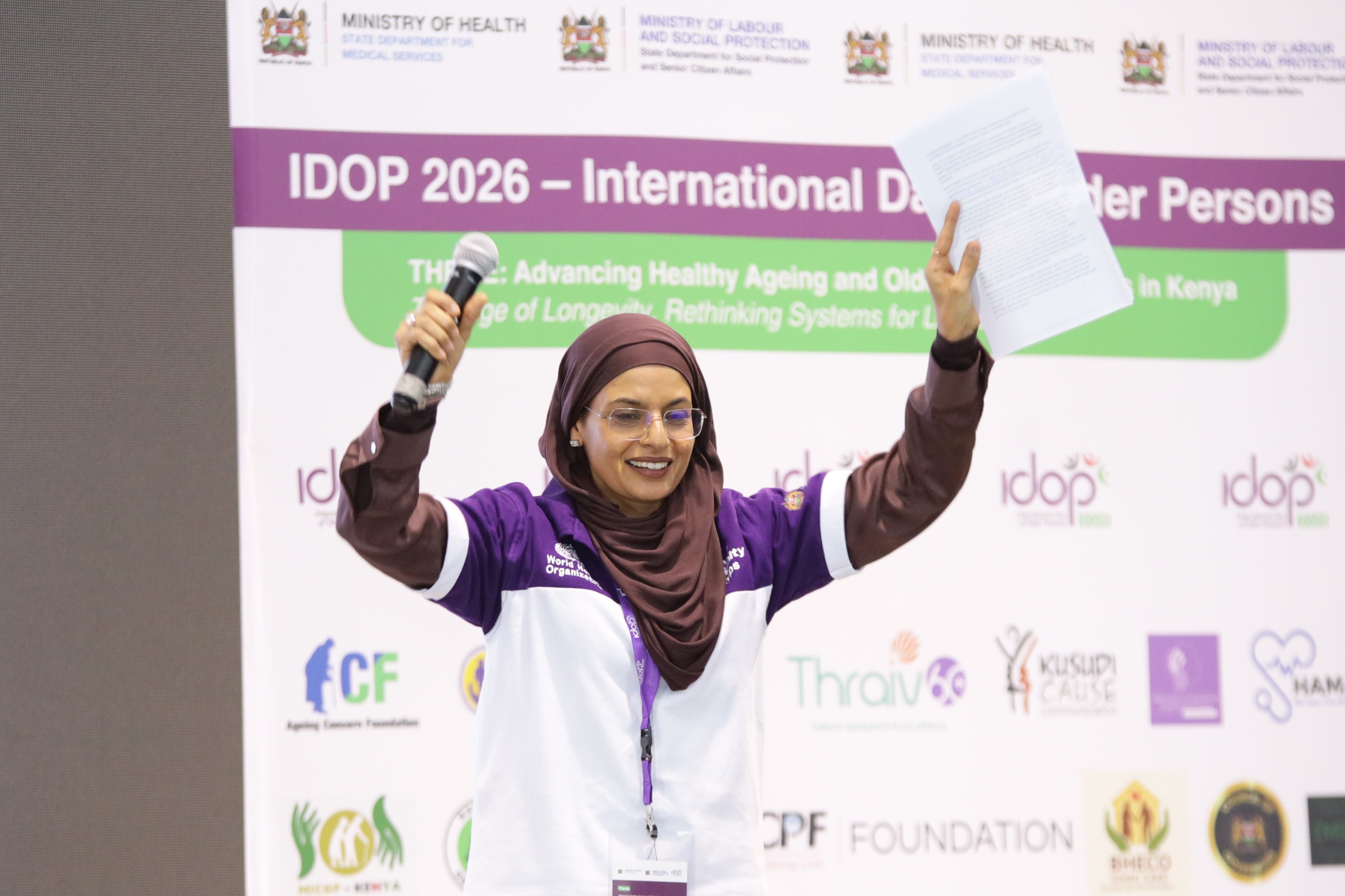
Kenya’s ageing population is putting pressure on the country to rethink how it protects older people, with calls growing for social protection to focus on preventing ill-health and loss of independence rather than responding only after families fall into crisis.
Suqoon Founder Shakira Khawaja said longer lives must be supported by systems that allow older people to remain healthy, independent and economically and socially engaged.
Speaking during the Fourth Kenya Social Protection Conference in Nairobi, Khawaja said Kenya had made progress in extending life expectancy but needed to ensure its social protection systems were prepared for the demographic changes ahead.
“We worked hard for people to live longer. Now let us make sure our systems are ready for those longer lives, and that those lives are lived with function, contribution and dignity,” she said.
Her remarks came as the Government announced measures aimed at expanding social protection coverage and strengthening the financing of social assistance programmes.
President William Ruto, in a speech read on his behalf by Labour and Social Protection Cabinet Secretary Alfred Mutua, committed the Government to establishing and capitalising a Social Protection Fund and making benefit indexation predictable.
The Government also plans to expand social protection coverage to 2.5 million households.
The President further directed that a national school meals programme be rolled out across all 47 counties in the first term of 2027.
The measures come as Kenya prepares for a substantial increase in the number of older people.
Specialists briefing the media ahead of Kenya’s inaugural International Day of Older Persons national celebration said the population aged 60 and above is projected to rise from about 2.9 million currently to 6.4 million by 2045.
The projected increase is expected to have implications for healthcare, household incomes, caregiving and public spending.
Khawaja said the relationship between health and social protection was particularly important because seemingly minor health incidents can quickly create financial and social pressures for entire families.
A fall at home, for instance, can result in a fracture, hospitalisation, reduced mobility and dependence on a caregiver. In some cases, family members may have to leave work to provide care.
Suqoon, in partnership with organisations including Safaricom and the Chandaria Foundation, has been modifying homes occupied by older people to reduce the risk of falls.
“That grab rail is not just a renovation. It is health protection. It is caregiver protection. It is social protection,” Khawaja said.
She challenged policymakers to consider such preventive interventions as part of the wider social protection system.
Khawaja also identified gaps that she said should be addressed as Kenya strengthens its framework for older persons.
Among them is the gap between the age of 60, when the Constitution recognises a person as an older person, and 70, when the Older Persons Cash Transfer begins.
She called for a clear pathway to protect people during this period, arguing that vulnerability does not begin at a fixed age.
She also urged stronger safeguards for older people’s income, property and assets against abuse.
Khawaja called for the Older Persons Bill, 2024 to be introduced in Parliament. Public participation on the Bill had been completed in 2024, but it had not yet been tabled in Parliament.
She further called for an assisted option for older people who are unable to use digital payment platforms and other digital services independently.
The issue is becoming more significant as government services and financial transactions increasingly move online, potentially creating barriers for older people with limited access to technology or difficulties navigating digital systems.
Beyond formal social protection programmes, Khawaja said Kenya also needed to recognise the continuing role older people play in their families and communities.
Many older people remain involved in farming and small businesses, raise grandchildren, participate in chamas and provide support to other family members.
“An elder is not where the life cycle closes. She is where it turns. When we invest in an older person, the return does not stop with her. It moves through the family, the community and into the next generation,” she said.
The role of community interaction was echoed by older people involved in Suqoon activities in Mathare and Embakasi.
Ann Wanjiru Mbuthia, 64, Organising Secretary at Mathare Older Persons Network, said greater interaction between generations could improve understanding of the challenges facing older people.
“We need more conversations between generations. Young people need to understand what older people go through and why they need to be cared for. There is a lot that younger people can learn from older people,” she said.
For Peter Oyugi, 65, from Embakasi, social isolation is another challenge that needs attention.
He said community activities had provided older people with an opportunity to leave their homes, interact with others and maintain a sense of belonging.
“Suqoon has given us a space where we can come together, talk and interact. Sometimes an older person can stay in the house for many days without going anywhere. Having this space gives us a reason to come out and feel part of the community,” Oyugi said.
The Fourth Kenya Social Protection Conference, held from 29 September to 1 October, brought together stakeholders to examine how Kenya can strengthen its social protection systems amid demographic, economic and climate-related pressures.
Held under the theme, “Re-imagining Social Protection in an evolving socio-economic landscape and climate change: Strengthening Adaptive, Transformative and Sustainable Social Protection Systems for Inclusive Development in Kenya,” the conference placed ageing among the wider challenges confronting Kenya’s social protection system.
With the number of older Kenyans expected to more than double over the coming two decades, the debate is increasingly shifting from whether the country should prepare for an ageing population to how quickly it can put the necessary systems in place.