BOOK REVIEW: Forward Deployed and the Palantir Formula for Turning Artificial Intelligence into Business Results
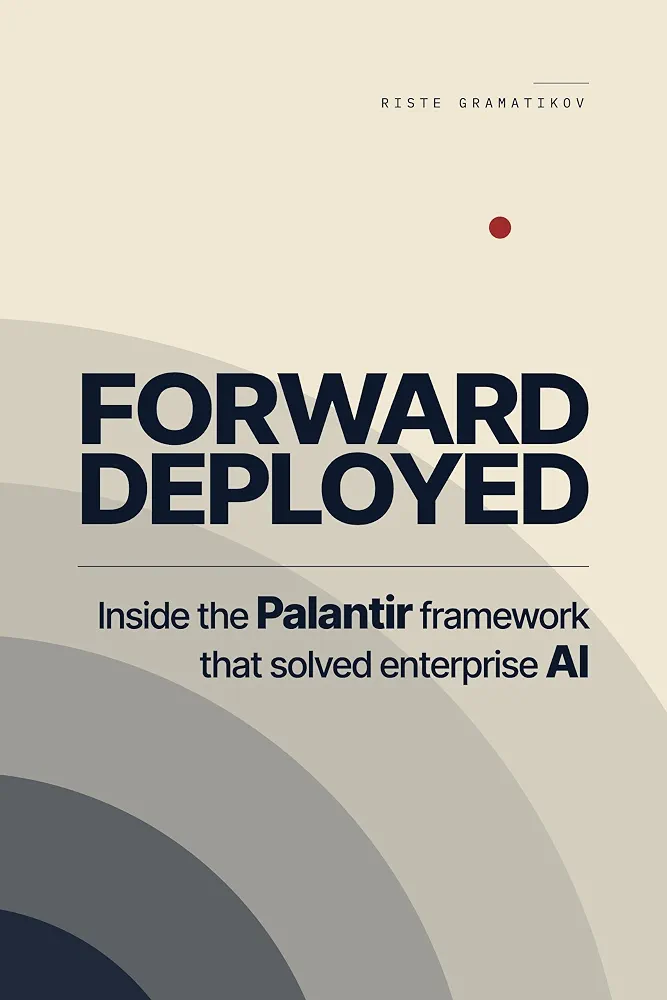
Book: Forward Deployed: Inside the Palantir Framework That Solved Enterprise AI[Text Wrapping Break]Author: Riste Gramatikov[Text Wrapping Break]Genre: Business strategy, technology, organisational culture and artificial intelligence
The promise of artificial intelligence is everywhere. Businesses are investing in data platforms, automation tools and AI-powered applications, hoping to cut costs, improve productivity and gain an advantage over competitors.
Yet the gap between technological capability and measurable business results remains one of the biggest challenges facing corporate leaders.
In Forward Deployed: Inside the Palantir Framework That Solved Enterprise AI, Riste Gramatikov examines this problem through the experience of Palantir Technologies, the American software company that has built its business around helping organisations solve complex operational challenges.
His argument is both ambitious and provocative. The failure of enterprise transformation, he contends, is rarely explained by technology alone. Organisations struggle because their structures encourage imitation, their talent systems reward conformity, their departments operate in silos and their leaders underestimate the human difficulties involved in changing established ways of working.
Palantir’s approach, as Gramatikov presents it, offers an alternative. Rather than selling software and leaving customers to figure out implementation, the company combines technology with embedded technical teams, distinctive organisational principles and a disciplined approach to solving operational problems.
The result is a book that seeks to explain not simply how Palantir builds software, but how it has developed a system for getting that software adopted and turning it into a source of competitive advantage.
This distinction gives the book its relevance beyond the technology sector. For business executives, entrepreneurs, policymakers and anyone responsible for digital transformation, its central question is worth considering: what happens when technology deployment becomes a core organisational capability rather than an external project?
Challenging the instinct to imitate
The intellectual foundation of the book is the concept of anti-mimetic thinking. Gramatikov argues that organisations frequently make decisions by copying what competitors do, rather than independently assessing what their circumstances require.
Businesses recruit from the same universities, adopt similar management structures, pursue comparable markets and purchase technology on the strength of industry trends. Such behaviour may appear sensible because it reduces the perceived risk of departing from accepted practice. However, when everyone follows the same path, differentiation becomes difficult and the underlying problems remain unresolved.
The author applies this argument to Palantir’s customer selection, organisational structure and recruitment practices. The company’s willingness to pursue complicated, high-stakes problems that other software providers may avoid is presented as a deliberate alternative to competing in crowded markets on conventional terms.
The discussion of privacy and security provides an important historical foundation. Following the September 11, 2001, terrorist attacks, governments faced pressure to strengthen intelligence capabilities while protecting democratic freedoms. Gramatikov explains how the apparent conflict between privacy and security informed the thinking behind Palantir’s founding.
The significance of this example extends beyond the company's origins. It illustrates the possibility of challenging a perceived trade-off rather than accepting it as inevitable.
For business leaders, the lesson is that innovation often begins with questioning the assumptions that define a market. An organisation does not necessarily gain an advantage by doing what everyone else does more efficiently. It may gain one by identifying a problem that conventional approaches have failed to solve.
However, anti-mimetic thinking should not be confused with rejecting established practice for its own sake. Copying a proven approach can be sensible, just as unconventional thinking can lead to expensive mistakes. The real value of Gramatikov's argument lies in encouraging deliberate judgment rather than reflexive imitation.
Culture is not a corporate slogan
The book becomes more compelling when it examines how philosophical principles influence the way an organisation operates.
Gramatikov identifies three central principles in Palantir’s culture: reality as the referee, disagreement as a duty, and systems over scapegoats.
Together, these ideas challenge familiar corporate habits. Reality as the referee means judging decisions by their results rather than by the seniority or confidence of the person proposing them. Disagreement as a duty encourages employees to challenge assumptions instead of remaining silent to preserve harmony. Systems over scapegoats directs attention towards the underlying processes that produce failure rather than simply blaming individuals.
These principles are easy to endorse in theory. Their practical application is considerably harder, particularly in organisations where hierarchy determines whose opinions carry weight or where employees fear the consequences of challenging senior managers.
Gramatikov argues that principles must be embedded in the structures through which people work. His discussion of Palantir’s relatively flat organisational arrangements illustrates an attempt to reduce the competition for titles and status that can distract employees from substantive work.
The broader point is that organisational culture is not created by mission statements alone. It is reinforced through recruitment, incentives, decision-making processes and the behaviour leaders reward.
This is a useful contribution to management literature because it moves the discussion away from the vague instruction to build a better culture. It asks executives to consider which specific organisational arrangements encourage the behaviour they want.
Nevertheless, a flatter hierarchy does not automatically eliminate power struggles. Influence can accumulate informally, and employees may still compete for recognition, access to leadership or control over important decisions. The challenge for any organisation is not to pretend that status disappears, but to prevent status competition from overwhelming the pursuit of results.
The talent system: hiring for more than credentials
Chapter Four extends the anti-mimetic argument to recruitment and talent development.
Gramatikov challenges the tendency of companies to recruit from the same institutions, use similar interview processes and evaluate candidates against increasingly standardised profiles. Such systems can produce teams that look impressive on paper but share similar assumptions and approaches to problem-solving.
Palantir’s talent system, as described in the book, seeks individuals who are motivated by the mission and capable of operating in demanding, uncertain environments. The author traces the development of this approach through constraints, unsuccessful methods and the eventual discovery of practices that became part of the company's recruitment and development system.
The important distinction is between hiring people who can perform a defined task and developing people who can identify what needs to be done when the task itself is unclear.
This is particularly relevant in enterprise AI, where technical specialists frequently encounter incomplete information, conflicting departmental priorities and operational problems that cannot be resolved through coding alone.
The chapter also raises a question for business leaders: are their recruitment systems designed to identify the people their organisations actually need, or do they reproduce the preferences of their competitors?
Gramatikov's account is persuasive in showing why conventional recruitment criteria deserve scrutiny. Its broader claims about the superiority of Palantir's approach, however, should be evaluated against independent evidence and the realities of other organisations. A recruitment system that works in one corporate culture will not necessarily produce the same outcomes elsewhere.
Why deployment requires human intelligence
One of the book's most original sections concerns the skills needed to implement technology in complex organisations.
Palantir's forward-deployed engineers work closely with customers, engaging directly with the problems the software is intended to solve. They must understand technical systems, but they must also navigate institutional resistance, conflicting priorities and the everyday habits that determine whether new tools are adopted.
Gramatikov connects these demands to improvisational theatre, drawing on Keith Johnstone's Impro: Improvisation and the Theatre. The comparison is unexpected, but it serves a clear purpose.
Improvisation requires participants to listen carefully, read social dynamics, respond to changing circumstances and build on what others contribute. These skills are equally useful when a technical team encounters a sceptical manager, a resistant department or a customer whose actual needs differ from the original project brief.
The book's treatment of communication is particularly valuable because technology projects are often managed as if explaining the technical benefits of a system should be enough to secure adoption.
In reality, employees may fear losing authority, managers may resist changes to established reporting arrangements, and departments may be reluctant to share information. These are organisational problems that cannot be resolved simply by adding more software features.
The forward-deployed model attempts to address this challenge by placing technical capability close to the customer. Instead of delivering a finished product and withdrawing, the team works alongside the organisation as its needs become clearer.
This approach also challenges the traditional consulting model, in which external advisers may recommend changes but leave the client responsible for executing them. Embedding implementation capability creates the possibility of building knowledge within the organisation rather than allowing it to disappear when a contract ends.
The model is not without costs. Skilled deployment teams are expensive, difficult to scale and dependent on strong relationships with customers. Their effectiveness also depends on whether the organisation is willing to change. Nevertheless, Gramatikov makes a strong case for treating implementation expertise as a strategic asset.
Foundry and AIP: from information to action
The book's technical centre is its examination of Palantir Foundry and the Artificial Intelligence Platform, or AIP.
Gramatikov argues that Foundry should be understood as more than a conventional data analytics platform. Its purpose, in his account, is to connect information from disconnected enterprise systems to the decisions and actions that determine business performance.
This distinction matters because large organisations frequently have extensive data resources without a reliable way to coordinate action across departments. Manufacturing, procurement, finance, quality control and customer service may each operate separate systems, leaving decision-makers unable to see how a problem in one area affects the rest of the business.
The book illustrates this challenge through a manufacturing scenario involving a brake recall crisis. A defective component can create consequences across production, supplier management, finance and customer service. Resolving the problem requires more than identifying the defect. The organisation must establish which products are affected, determine the appropriate response and coordinate action across its operations.
Foundry's underlying model connects data, business processes and decisions through a shared operational structure. Gramatikov emphasises traceability and governance, including the ability to establish who made a decision, what information informed it and how the resulting action can be reviewed.
AIP builds on this foundation by allowing artificial intelligence to support and accelerate the configuration of enterprise workflows.
The argument is timely. Businesses increasingly have access to powerful AI models, but integrating them into established operations presents a more demanding challenge than producing an impressive demonstration. Models must work with relevant data, respect organisational rules and support decisions for which people remain accountable.
Gramatikov's distinction between analysing information and changing operational outcomes is therefore one of the book's strongest insights.
Yet the distinction also invites scrutiny. Calling a platform a decision automation system does not establish that its decisions will be correct, its integrations reliable or its outputs appropriate in every context. Data quality, security, governance, human oversight and the consequences of automated errors remain essential considerations.
The book is most useful when read as an explanation of Palantir's approach and its underlying logic, rather than as proof that a particular platform is the right solution for every enterprise.
The compound effect of reusable solutions
The discussion of the enterprise app store develops the book's argument about scaling transformation.
Successful deployments often contain lessons that could benefit other organisations. However, if each project begins from scratch, the knowledge accumulated by one team may not translate into faster or more effective implementations elsewhere.
Gramatikov describes how Palantir's applications can turn successful deployments into reusable templates. The book cites 66 documented use cases in the company's AIP catalogue at the time of writing, spanning areas such as manufacturing quality management, supply chain optimisation, predictive maintenance and regulatory compliance.
The significance lies in the possibility of combining standardisation with adaptation. A reusable application can provide a starting point, while deployment teams adjust it to the customer's data, processes and operating environment.
This approach offers a potential answer to one of the most difficult questions in enterprise technology: how can organisations move from isolated success stories to repeatable results?
The model's effectiveness, however, depends on how much of an earlier solution can genuinely be reused. Differences in data quality, legacy systems, regulation and organisational processes may still require substantial work. Templates can accelerate deployment, but they do not eliminate the need to understand the customer.
Even with this qualification, the chapter provides a useful way of thinking about institutional learning. Every project should ideally improve the organisation's ability to execute the next one.
Where the book falls short
The principal limitation of Forward Deployed is its strong focus on Palantir as the solution to the problems it identifies.
Gramatikov offers a coherent account of how the company's culture, talent system, deployment model and software platform reinforce one another. However, readers should distinguish between the explanatory power of this framework and independent evidence of its performance across different organisations.
A more extensive examination of unsuccessful implementations, competing approaches and the full costs of deployment would strengthen the argument. So would a deeper assessment of the circumstances in which embedded engineering teams deliver insufficient value, or where a less complex and less expensive technology solution may be more appropriate.
The book also raises important governance questions that deserve sustained attention. Greater integration and automation can improve coordination, but they can also concentrate decision-making power and increase the consequences of errors. Organisations adopting AI must consider privacy, accountability, security and the appropriate limits of automated action.
These are not reasons to dismiss the book's thesis. Rather, they define the questions executives should ask when translating its lessons into practice.
Palantir's experience is instructive, but no single corporate model can be assumed to work universally.
Final verdict: a business book with lessons beyond AI
Forward Deployed is ultimately a book about the relationship between technology and organisational capability.
Its greatest strength is the way it connects ideas that businesses often treat separately. Strategy determines which problems an organisation chooses to solve. Culture shapes how people approach those problems. Recruitment determines the capabilities available to the organisation. Deployment connects technical expertise to operational reality. Software enables the resulting solutions to scale.
The book's central insight is that these elements are most powerful when they reinforce one another.
For chief executives and business owners, it offers a framework for questioning why technology investments fail to deliver their expected returns. For technology leaders, it emphasises the importance of integration, implementation and governance. For entrepreneurs, it presents a case for competing through distinctive capabilities rather than following established market conventions.
Its advocacy of Palantir's model requires a critical reading, particularly where claims about performance and competitive advantage would benefit from broader comparative evidence. Nevertheless, the questions it raises are important for any organisation seeking to move beyond AI experimentation.
The ultimate measure of technological progress is not the number of systems installed, the volume of data collected or the sophistication of an AI demonstration. It is whether an organisation can make better decisions, execute them effectively and sustain the resulting improvements.
On that question, Gramatikov offers a compelling argument: the future of enterprise AI will depend as much on how businesses organise people and work as on the technology they purchase.
Recommended for: Business executives, entrepreneurs, technology professionals, management consultants, policymakers and readers interested in the practical realities of enterprise AI and digital transformation.
Get the copy Here